EXPERTLY CURATED HIGH-QUALITY POOL EQUIPMENT
HEATERS / PUMPS / FILTERS / CLEANERS / SANITIZATION / AUTOMATION / LIGHTING

HEATERS / PUMPS / FILTERS / CLEANERS / SANITIZATION / AUTOMATION / LIGHTING

The pool equipment that heats, cleans, lights, chlorinates, and controls your swimming pool needs to handle the demands of maintaining clean water flow. Within our pool equipment section, you won't find every product from every manufacturer, as that can be overwhelming. Instead, we've curated a selection of swimming pool equipment from companies and brands that we recommend and trust.
Select a product type below to explore everything within that category. You'll find product images, details, specifications, brochures, manuals, articles, and more.


ps. Yes, maintenance required. But no worries, we are here to help.
Are you curious about how to convert your pool to saltwater? You're not alone. Many pool owners are switching to salt, and it's not as complex as you may think.
Many pool owners may think that once you close your pool for the winter, you're finished taking care of your pool until the following spring. Simply not true. Your pool needs year-round attention! Between the winter precipitation coupled with freezing temperatures, real damage can occur to your pool. But no worries! We have some simple tips to follow to make sure that your pool is well taken care of during the winter months.
Recently we published an article about how to backwash DE filters. Monthly backwashing is a great way to keep your filter in good shape, but over time as dirt, grime, oils, etc. begin to buildup on your grids, you'll need more than just a backwash.
Here in Maryland, our pools are closed for about 5 - 6 months of the year, so giving your DE filter a full cleaning and inspection once a year is recommended.
The sand in your sand filter needs to be replaced every 3-5 years. Over time the sharp edges of the sand particle become worn and rounded, and the ability to capture contaminants is diminished. If you need a sand change, you will notice that your pool water is not as clean, and the interval between backwashing is shorter and shorter.
The pool filter is one of the most important yet often overlooked pieces of equipment within your circulation system. A filter doesn't require electricity, and there aren't many moving parts, but what it does have is pressure. Every pool filter has a pressure gauge, and by understanding how to read the pressure gauge, you will be able to see a snapshot of how your pool system is doing as a whole.
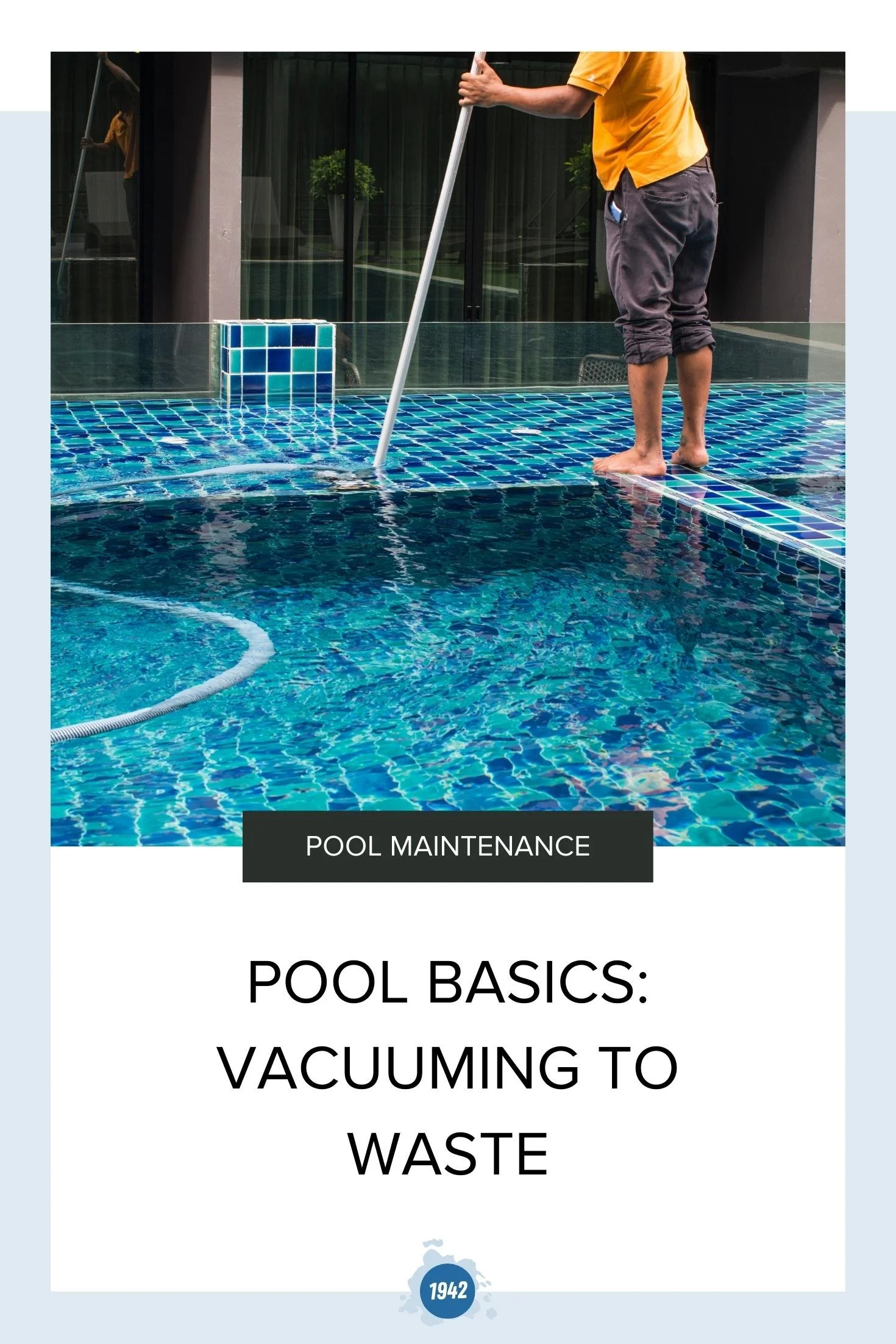
Every swimming pool needs a manual vacuum even if you own an automatic cleaner. Automatic cleaners are such a time-saving piece of pool equipment, but some issues can come up that your automatic cleaner cannot clean. THE TOP REASON TO VACUUM TO WASTE - ALGAE BLOOMS! The last thing you want to do is vacuum algae manually, which will contaminate your filter. Your pool will not clear up. In fact, the chances of your problem getting worse are very high. You'll also need to vacuum to waste when there is a large amount of debris or leaves in the pool, usually at opening.
Backwashing your pool is critical in maintaining healthy, clean, safe water. Let's take a look at what backwashing is and WHY, WHEN, and HOW to backwash your pool.
Backwashing a DE filter is a relatively simple process if you follow a few quick and easy steps. Let's take a look at WHY, WHEN, and HOW to backwash a DE filter with a multiport valve.
Sand filters are relatively easy to maintain. Let's take a look at WHY, WHEN, and HOW to backwash a sand filter with a multipart valve.
There are three types of pool filters: cartridge, sand, and DE (diatomaceous earth). Sand and DE filters use a multiport valve to help clean or backwash the filter media. Multiport valves are called multiport valves because they have multiple ports inside the valve that allows the water to move in multiple directions.
Your pool needs good circulation to keep the water clean. Good water circulation helps your pool's sanitation system, your filter, and your added chemicals do their job.
The pump basket is located in the pump housing assembly, and its purpose is to collect large debris that the skimmer missed or debris that was sucked through the main drain. This humble basket prevents debris from entering the pump assembly and clogging the impeller.
The pump is virtually the heart of your swimming pool's circulation system. Its sole purpose is to pull water from the pool through the skimmer and main drain. The water is then pushed through the filter and returned to the pool through the main returns. Just like the equipment for your home needs attention, the equipment for your swimming pool also requires routine maintenance. Let's take a look at some easy steps that will help keep your pool's pump in prime condition.
With fall approaching, this is the time to plan on upgrading your pool cover. It's common for pool owners to put off investing in a good quality cover. After all the pools being closed for the winter, what real difference does it make?
We've talked before about the top 2 best ways to extend your pool season with a gas heater or a heat pump. But if your not ready to shell out that kind of cash there are other ways that you can extend your pool season. The best part is you don't have to break the bank.
Living in the DC metropolitan area, there is no question that our swim season seems to always be cut way too short. Here we have the top 2 best ways to extend your pool season. We're talking extending your swim season by months! Who doesn't want that?
It's perfectly normal for your pool to lose water every day to evaporation, but if you notice an excessive loss of water, chances are you have a leak. A leak needs attention right away because the water level needs to be maintained in the middle of the skimmer. When your pool water level is too low, the skimmer takes in too much air, and this will cause problems with your pool system and will eventually cause the motor of your pump to burn out.
If the interior finish of your pool is plaster, quartz, or an aggregate finish like Wet Edge, knowing why, when, and how to brush your pool is essential. A thorough brushing prevents algae and extends the life of your pool surface, and believe it or not, there is a right way to brush your pool.
When you hear saltwater, most people think of the ocean, not swimming pool water. But now millions of pools worldwide are saltwater pools, so let’s take a look at what having a saltwater pool means. But before we get to that, I mentioned ocean water, and if you have ever gotten a mouthful of ocean water, then you know how salty the water tastes. A saltwater pool is not the same; in fact, just a drop of water from a saltwater chlorinated pool contains less salt than a human tear.
"Filtration, filtration, filtration!" Another critical piece of equipment for maintaining clean, safe pool water is your filter. The filter helps keep the pool clean by removing undissolved debris and dirt particles from your pool water.
There are three types of filters available: sand filters, cartridge filters, and D.E. filters. Each one has its pros and cons, but when used properly, any of the three will do its job of keeping your pool clean and clear.
The pool pump is the heart of your swimming pool's circulation system. It creates the flow of water that allows chemicals to circulate evenly throughout your pool and is instrumental in effectively sanitizing your water, and it moves debris through the circulation system and out of your pool.


These are the things that make our Service Department shine. We have proudly served Maryland, and the surrounding areas since 1942 and your pool and spa is our business! As experienced pool and spa professionals, we demonstrate our commitment to quality, expertise, safety, and professional excellence with PHTS - the Pool & Hot Tub Alliance (formerly APSP) Certification. We adhere to strict ethical standards and commit to the highest standards of service, performance, and conduct.